Hadler family murders
The DryThe Hadler family murders are the central crime of The Dry: Luke, Karen, and their young son Billy are killed, while their infant daughter survives. The scene initially appears to confirm a devastating account of family violence, but the crime’s details—including ammunition that does not match Luke’s usual supply—make that account increasingly doubtful. The contrast between the apparent explanation and the evidence turns the deaths into the investigation’s governing mystery.
Setting and Discovery
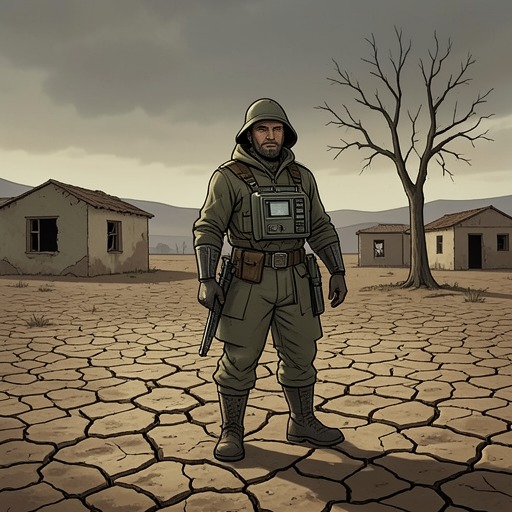
The murders occur during Kiewarra’s prolonged drought, when farmers have endured a second year of failed hopes for rain. The farm’s exposure and isolation shape the first account of the aftermath: laundry hangs dry and stiff, a child’s scooter is left on the path, and no one within a kilometer responds when the baby begins crying inside the house. The quiet surroundings do not soften the scene; they underline how completely the family has been cut off from help.
The bodies are found in two parts of the property. Luke is in a clearing, while Karen and Billy are inside the farmhouse. The baby’s cries establish that an infant has survived, but the sound goes unanswered in the immediate aftermath. The arrangement of the scene encourages the assumption that Luke killed his family and then himself, an interpretation repeated by townspeople and initially supported by the discovery of his licensed shotgun beside him.
Evidence and Reconstruction
The first break in the apparent explanation comes from the ammunition. Greg Raco finds that the three cartridges used in the killings were Remington, whereas the ammunition he can locate on the property is Winchester; Luke Hadler had used a different brand for years. The discrepancy makes the shotgun beside Luke insufficient to settle who fired it, and turns what seemed to be a straightforward murder-suicide into a question of staging.
Security footage adds a timed trace of Luke’s silver pickup. Aaron Falk and Raco watch it appear, remain on the recording during the interval when the gunshots are heard, and leave three minutes and forty-seven seconds after first arriving. No other vehicle comes or goes before the courier arrives thirty-five minutes later. The footage does not show the person responsible, but it fixes Luke’s truck at the farm during the killings and gives the investigation a sequence to test against the initial account.
The later reconstruction identifies Scott Whitlam as the killer. After Luke encounters him, Whitlam knocks Luke unconscious, puts him in the pickup, and loads Luke’s shotgun with Remington ammunition taken from the school. He drives to the Hadler farmhouse, where Karen opens the door and Whitlam shoots her. Billy is also present, despite Whitlam’s expectation that he would be elsewhere; Whitlam finds him hiding in the bedroom and shoots him. The baby is in the nursery and survives. Whitlam then drives Luke’s body to a clearing, arranges it with the shotgun to suggest suicide, and leaves the scene. The mismatched cartridges and the pickup’s movements are thus not incidental irregularities: they point away from Luke and toward a staged account of the family’s deaths.
Public Judgment and the Personal Mystery
The apparent murder-suicide quickly becomes a public verdict. Sandra Whitlam speaks of Luke as the man who killed his wife and child, a certainty that shows how readily the town’s first explanation hardens into blame. Yet for Aaron Falk, the conclusion remains difficult to imagine: even after trying repeatedly, he cannot make the image of Luke pursuing Billy fully come into focus.
The difficulty is sharpened by Falk’s memories of the child and his father. Billy’s paintings at the farmhouse show cheerful scenes—airplanes carrying smiling people and many variations on cars—details that make Falk’s knowledge of the boy’s fate impossible to hold at a distance. His recollection then turns to his last meeting with Luke, five years earlier in Melbourne. Luke still seemed energetic, but Falk recognizes that by then he had barely known his old friend. The murders therefore leave him confronting both the question of who killed the family and the uncomfortable distance that had grown between the two men before Luke’s death.
Staging and the Reversal of the Initial Account
The reconstruction also explains how the apparent murder-suicide was manufactured. When Luke encountered Scott Whitlam, Whitlam attacked him with a sock packed with stones, then used gloves taken from the school science lab to move him into Luke’s pickup. Luke’s shotgun was unloaded; Whitlam loaded it with Remington ammunition from the school before driving to the farmhouse. These details connect the ammunition discrepancy not just to the weapon, but to Whitlam’s access to the school and his deliberate preparation of the scene.
After the killings, Whitlam returned Luke to the clearing and arranged the shotgun to make his death appear self-inflicted. The tarpaulin and Whitlam’s bicycle helped conceal traces left in the pickup during the journey; he then left by bicycle. What first seemed to be a single, self-contained act was therefore a sequence involving two locations, a borrowed vehicle, and evidence deliberately made to implicate Luke. The investigation’s central reversal rests on that difference: the scene looked like an explanation, but its details recorded the labor of staging one.